

Laccase Handling, Storage, and Production Use | Laccase Enzyme Solutions
Practical guidance for storing, handling, dispersing, and using Laccase powder in industrial production environments, with notes for plant trials, compatibility, and procurement.
Laccase (benzenediol:oxygen oxidoreductase) is a copper-containing oxidoreductase used where controlled oxidation is valuable: textile and denim finishing, pulp and paper modification, phenolic wastewater treatment, plant extract stabilization, wine processing, biopolymer functionalization, and specialty chemical production.
For production teams, the enzyme is not difficult to work with — but it does reward disciplined handling. Moisture control, dust control, oxygen transfer, substrate access, and compatibility checks determine whether a laccase trial becomes a repeatable plant process.
This guide is for production, warehouse and purchasing teams at manufacturers, mills and treatment sites, and for distributors and resellers who hold laccase stock: how to receive, store, open, disperse and run bulk laccase powder in production.
Wholesale and bulk supply. For manufacturers, distributors and resellers. Send the application and supply format, the quantity you need and the destination country; every order is quoted individually. Request a quote
What laccase needs to work well
Laccase oxidizes phenolic, polyphenolic, aromatic amine, and related electron-rich substrates while reducing oxygen to water. In practical terms, the process requires four conditions to align:
- Accessible substrate — phenolic groups or other oxidizable sites must be available to the enzyme.
- Suitable water phase — enough water for enzyme mobility and substrate contact.
- Process oxygen — dissolved oxygen or effective air exchange to support oxidation.
- Compatible chemistry — no aggressive oxidants, reducing agents, or inhibitors that overwhelm the enzyme.
In some applications, redox mediators are used to broaden the range of substrates laccase can affect. Mediators should be treated as process chemicals, not generic enhancers: validate their effect on product quality, effluent profile, worker exposure, odor, color, and downstream separation before scaling.
Receiving bulk laccase powder
When laccase arrives, inspect the shipment before moving it into production inventory.
Check on arrival
- Confirm product name, lot number, pack count, and seal integrity.
- Look for signs of water exposure, puncture, caking, excessive heat exposure, or damaged secondary packaging.
- Match the lot to the certificate of analysis, safety data sheet, and purchasing documents.
- Record arrival date, storage location, and responsible operator.
- Quarantine any compromised pack until quality or procurement has reviewed it.
Documentation to retain
For production use, keep the following available to quality, EHS, and operations:
- Certificate of analysis for the specific lot.
- Safety data sheet.
- Allergen, origin, and regulatory statements where relevant to the application.
- Change-control or notification expectations for future supply.
- Recommended storage and handling conditions.
Procurement should align documentation requirements before the first shipment, especially for food-adjacent, beverage, textile export, pulp and paper, cosmetics-adjacent, or wastewater applications with permitting implications.
Storage: protect from heat, humidity, and contamination
Laccase powder should be stored sealed, dry, and cool. The main storage risk is not dramatic failure; it is gradual performance loss caused by moisture uptake, repeated warming, and poor resealing.
Recommended storage practice
- Keep unopened packs in their original sealed packaging.
- Store in a cool, dry, shaded area away from steam lines, washdown zones, boilers, direct sun, and roof heat.
- Use refrigerated storage when specified for the lot or when long holding periods are expected.
- Avoid freeze-thaw cycling if the material has been conditioned or temporarily staged.
- Keep enzyme away from strong-smelling chemicals, solvents, oxidizers, reducing agents, and open water sources.
- Apply first-in, first-out stock rotation.
- Return partially used packs to sealed, moisture-controlled storage immediately after use.
Opened pack management
Once opened, treat the pack as production-sensitive material.
- Open only what the batch plan requires.
- Minimize time exposed to plant air.
- Use clean, dry scoops and dedicated tools.
- Do not return spilled or exposed powder to the original container.
- Reseal with a clean inner closure and intact outer closure.
- Label the opened date, operator, and remaining quantity.
If the powder becomes visibly caked, damp, contaminated, or discolored, hold it for review rather than charging it to a production batch.
Worker handling and dust control
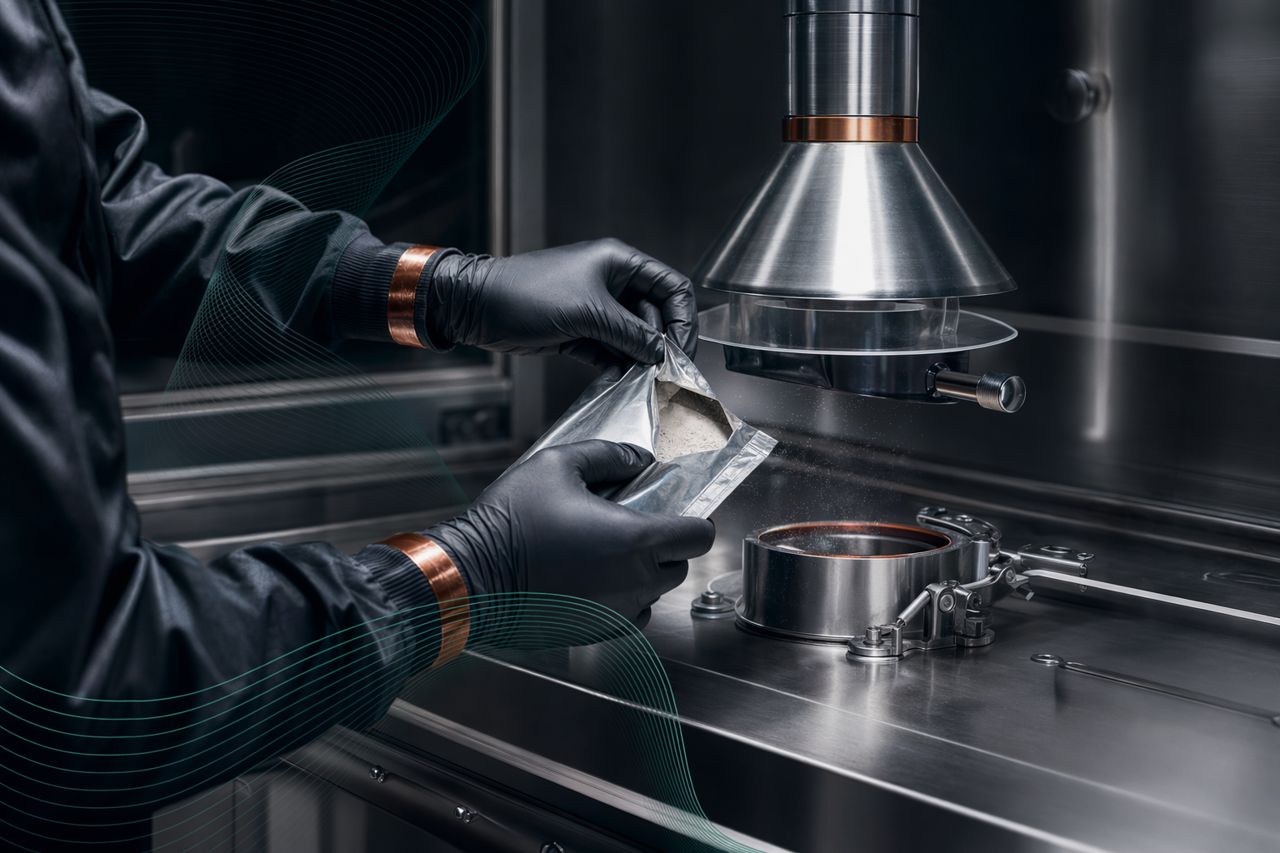
Enzyme powders can sensitize respiratory systems if airborne exposure is not controlled. Treat laccase as a functional bio-based processing aid with industrial hygiene requirements, not as an ordinary dry ingredient.
Good plant practice
- Review the safety data sheet before first use.
- Use local exhaust or contained transfer where powder is opened or charged.
- Avoid pouring from height, compressed-air cleaning, or dry sweeping.
- Wear PPE specified by the site risk assessment and safety data sheet.
- Use respiratory protection where dust exposure cannot be controlled by engineering methods.
- Keep enzyme handling areas clean, dry, and clearly identified.
- Train operators on spill response before production trials begin.
Spill response principles
- Restrict access and avoid raising dust.
- Use wet wiping, compatible vacuum systems, or controlled collection methods approved by EHS.
- Prevent entry into drains unless the site procedure allows it.
- Dispose of collected material according to local site procedure and application context.
Preparing laccase for addition
Laccase is commonly added as a powder or as a prepared slurry/premix, depending on the process. The goal is uniform distribution without localized over-concentration, shear damage, clumping, or contact with incompatible chemicals.
Practical dispersion guidance
- Prepare the vessel or premix water before opening the enzyme.
- Avoid adding powder directly onto dry solids unless the process has been validated for that addition order.
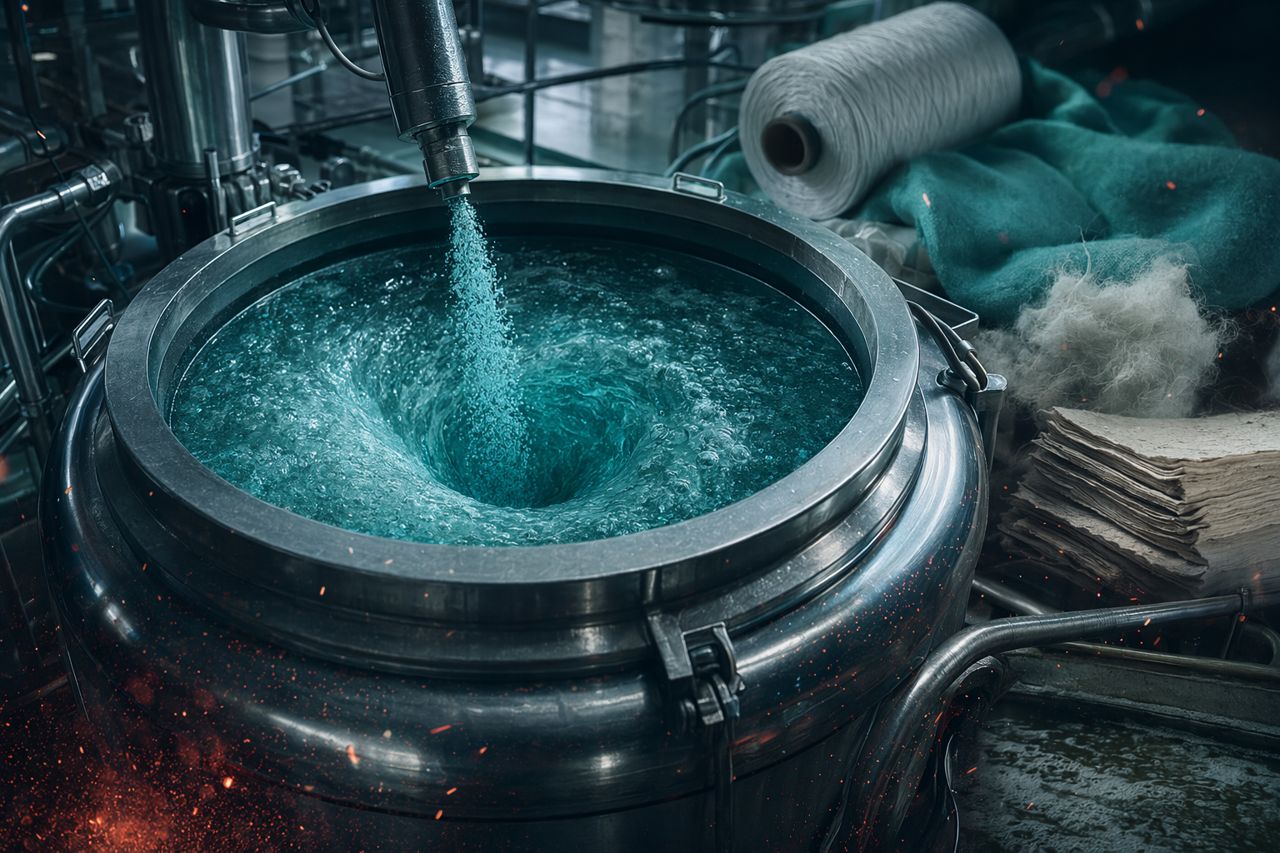
- Add slowly into moving liquid with moderate agitation.
- Avoid high-shear devices unless validated for the formulation.
- Do not add into hot process zones, caustic concentrates, oxidant concentrates, or solvent-rich pockets.
- Keep premix hold time short unless stability has been confirmed for the specific formulation.
- Charge laccase after pH and temperature have been adjusted into the agreed operating window.
For slurry preparation, use compatible process water and clean vessels. If the water contains high sanitizer carryover, residual peroxide, sulfite, chlorine, or heavy metal contamination, test compatibility before relying on the premix in production.
Operating window considerations
The correct process window depends on the laccase source, formulation, substrate, mediator system, and product objective. Still, most production issues fall into familiar categories.
pH
Laccase performance is strongly pH-dependent. The best pH for one substrate may not be the best pH for another because oxidation potential, substrate solubility, mediator behavior, and product stability all shift with pH.
Plant implication: set pH before enzyme addition, monitor drift during reaction, and avoid adding laccase into concentrated acid or alkali.
Temperature
Temperature affects reaction rate and enzyme stability at the same time. Warmer conditions can accelerate oxidation, but excessive temperature shortens useful enzyme life and may create uncontrolled color, odor, or viscosity changes in sensitive substrates.
Plant implication: charge below the validated upper temperature, watch heat from upstream processing, and do not assume a hotter batch is a faster batch.
Oxygen availability
Laccase uses oxygen as the terminal electron acceptor. If oxygen transfer is poor, the batch may appear under-dosed even when enzyme and substrate are present.
Plant implication: evaluate agitation, surface exchange, headspace, air entrainment limits, foam control, and vessel fill level during scale-up.
Contact time
Oxidative transformations often continue until substrate access, oxygen, mediator balance, or enzyme stability becomes limiting. In production, contact time should be tied to measurable batch criteria rather than a fixed assumption from bench work.
Plant implication: define stop criteria before the trial begins.
Compatibility: what to test before scale-up
Laccase can be robust in the right environment and fragile in the wrong one. Run compatibility screens using the actual plant water, substrate, auxiliaries, and cleaning carryover profile.
Common materials to review
- Strong reducing agents.
- Chlorine, hypochlorite, peroxide, peracids, and other aggressive oxidants.
- Sulfite and bisulfite systems.
- Chelating agents, especially where copper coordination may be affected.
- High solvent levels.
- Residual sanitizers.
- Heavy metal contamination.
- High salt matrices.
- Cationic or anionic surfactant packages.
- Dyes, tannins, lignin fragments, and phenolic extracts that may shift color rapidly.
Compatibility does not mean the enzyme must avoid every listed material. It means the process owner should test the actual concentration, addition order, exposure time, and quality endpoint before plant commitment.
Application-specific production notes
Textile and denim processing
Laccase may be used for controlled color modification, indigo-related effects, or auxiliary oxidative finishing. Key variables include fabric loading, liquor movement, dye chemistry, redeposition control, oxygen transfer, and post-treatment rinse strategy.
Watch for uneven shade change when enzyme distribution, fabric movement, or oxygen access is inconsistent.
Pulp, paper, and fiber modification
In fiber systems, laccase performance depends on lignin accessibility, pulp consistency, pH, temperature, oxygen, and the presence or absence of mediator chemistry. Downstream impacts may include drainage, brightness behavior, wet-end chemistry, and effluent character.
Evaluate enzyme addition point carefully. Upstream residues and downstream additives can both influence outcome.
Phenolic wastewater and process streams
Laccase can oxidize phenolic compounds into larger, more separable structures under the right conditions. The practical objective may be color change, toxicity reduction, polymer formation, filtration improvement, or improved downstream treatment behavior.
Confirm sludge behavior, filtration rate, residual color, odor, and permit-relevant parameters during pilot work.
Wine, beverage, and botanical extracts
Laccase can alter phenolic profiles, color stability, haze behavior, and oxidation pathways. In these applications, quality impact can be beneficial or unacceptable depending on the matrix.
Run sensory, color, filtration, and shelf-stability checks before production adoption.
Scale-up from bench to plant
A small beaker trial rarely captures oxygen transfer, substrate heterogeneity, agitation limits, tank geometry, foam behavior, or plant water chemistry. Scale-up should be structured.
Suggested trial sequence
- Bench screen — confirm the chemistry works in the real substrate.
- Compatibility screen — test plant water, additives, pH adjusters, preservatives, and cleaning carryover risks.
- Pilot batch — verify mixing, oxygen transfer, contact time, product quality, and stop criteria.
- First production batch — run with enhanced sampling and operator observation.
- Routine specification — lock addition order, operating window, hold time, acceptance criteria, and documentation.
Retained samples
For each trial, retain samples from:
- Substrate before enzyme addition.
- Early reaction stage.
- Target endpoint.
- Post-stop or downstream stage.
- Finished product or treated effluent.
Label samples with lot, time, pH, temperature, process stage, and operator initials.
Stopping or controlling the reaction
The correct stop method depends on the application. Common approaches include temperature adjustment, pH shift, removal of substrate contact, filtration, chemical quench where permitted, or simply moving to a downstream stage where conditions no longer favor laccase performance.
Do not select a stop method only because it works in the lab. Confirm that it is compatible with product quality, wastewater handling, equipment metallurgy, worker safety, and regulatory expectations.
Procurement questions to settle before ordering
Before placing a production order, align technical and commercial expectations.
Ask before purchase
- What substrate and application is the laccase intended for?
- Is mediator chemistry required or avoided?
- What pH and temperature window will production run?
- What packaging format best matches batch size and open-pack policy?
- What shelf-life and storage conditions are needed for inventory planning?
- What documentation is required for quality, EHS, customers, or regulators?
- What change-notification process is expected?
- Is a trial quantity, pilot quantity, or recurring supply plan needed?
For procurement teams, the lowest purchase price is not the full cost. Rework, failed trials, poor dispersion, short open-pack life, and inadequate documentation can be more expensive than the enzyme itself.
Troubleshooting quick guide
| Plant observation | Likely area to investigate | Practical response |
|---|---|---|
| Slow or incomplete reaction | Oxygen transfer, pH, temperature, substrate access, inhibitor carryover | Check pH and temperature logs, improve mixing or air exchange, review additive carryover |
| Uneven color or surface effect | Poor dispersion, uneven substrate movement, localized enzyme concentration | Change addition point, premix strategy, agitation, or load pattern |
| Unexpected darkening | Substrate over-oxidation, mediator effect, long contact time | Reduce contact time, review endpoint, test without mediator if applicable |
| Clumping during addition | Moisture exposure, fast charging, poor liquid movement | Add more slowly, improve wetting, use dry tools, review storage |
| Batch-to-batch variation | Water chemistry, raw material variation, enzyme storage, oxygen availability | Track lots, retain samples, standardize staging and vessel conditions |
| Downstream filtration change | Polymer formation, fiber modification, colloid shift | Test endpoint timing, filter aid strategy, and separation conditions |
Production readiness checklist
Use this checklist before the first plant batch:
- Lot documentation received and approved.
- Storage location assigned and temperature/humidity exposure controlled.
- SDS reviewed by EHS and operators.
- PPE and dust-control measures in place.
- Addition point, addition order, and premix method defined.
- pH and temperature setpoints validated for the process.
- Oxygen transfer assumptions reviewed for the actual vessel.
- Incompatible additives and cleaning residues checked.
- Sampling plan and retained sample labels prepared.
- Batch endpoint and stop method defined.
- Deviation response agreed before charging enzyme.
- Procurement plan aligned with expected open-pack use and inventory turnover.
Laccase Enzyme Solutions responds with application-led questions first, because the right laccase plan depends on substrate, oxygen transfer, operating window, and downstream quality targets.
Request a quote for laccase
Laccase Enzyme Solutions supplies laccase wholesale to manufacturers, mills, treatment providers, formulators, distributors and resellers. Price, pack size and lead time are quoted per order.
To get a quote, send:
- the application and how the enzyme will be dosed (batch or continuous)
- the quantity you need per order, or your expected monthly volume
- the destination country
- liquid or powder preference, and process pH and temperature if known

More from Laccase Enzyme Solutions
Laccase for Bioremediation and Micropollutant Treatment: Bulk Supply | Laccase Enzyme Solutions
Laccase for Biosensors and Functional Materials | Laccase Enzyme Solutions
Laccase for Cosmetic and Personal Care Formulation Research | Laccase Enzyme Solutions
Laccase for Food Processing & Ingredient Modification | Laccase Enzyme Solutions
Laccase for Green Oxidation Chemistry | Laccase Enzyme Solutions
Laccase for Lignin-Based Biomaterials | Laccase Enzyme Solutions
Request pricing & specs
Tell us your application and volume — we reply with pricing and lead time.
We have received your message. We will reply by email.