

Choosing Laccase for an Industrial Process
A practical buyer guide to selecting Laccase (benzenediol:oxygen oxidoreductase) for textiles, pulp and paper, phenolic wastewater, beverages, extracts, and biobased materials.
Choosing Laccase for an Industrial Process
Laccase is not a general-purpose cleaner. It is an oxidative enzyme for controlled phenolic chemistry.
For formulation, process, and procurement teams, the key question is not simply whether Laccase works. The practical question is whether Laccase fits the substrate, oxygen availability, process pH, contact time, mediator policy, downstream separation, and documentation requirements of the application.
Laccase Enzyme Solutions approaches Laccase selection from the process outward: what needs to be oxidized, what must remain untouched, and what commercial constraints define a successful run.
This guide is for the people who specify and order laccase: process engineers, formulators and purchasing teams at manufacturers, mills and treatment providers, and the distributors and resellers who supply them.
Wholesale and bulk supply. For manufacturers, distributors and resellers. Send the application, the quantity you need and the destination country; every order is quoted individually. Request a quote
What Laccase does
Laccase (benzenediol:oxygen oxidoreductase) catalyzes one-electron oxidation of phenolic and related aromatic substrates while reducing oxygen to water. In industrial terms, it can help convert reactive phenolics into larger, less soluble, more separable, or more stable structures.
That mechanism can be useful when a process needs to:
- Modify lignin-rich materials
- Reduce phenolic load in process water
- Support color adjustment or stain transformation
- Stabilize plant extracts, juices, wines, or other polyphenol-rich matrices
- Crosslink or functionalize biobased polymers
- Replace harsher oxidation chemistry with a more selective oxygen-driven step
Laccase performance depends strongly on the surrounding matrix. The same enzyme that performs well in a lignin stream may behave differently in a beverage, textile bath, or wastewater liquor.
Where Laccase is commonly evaluated
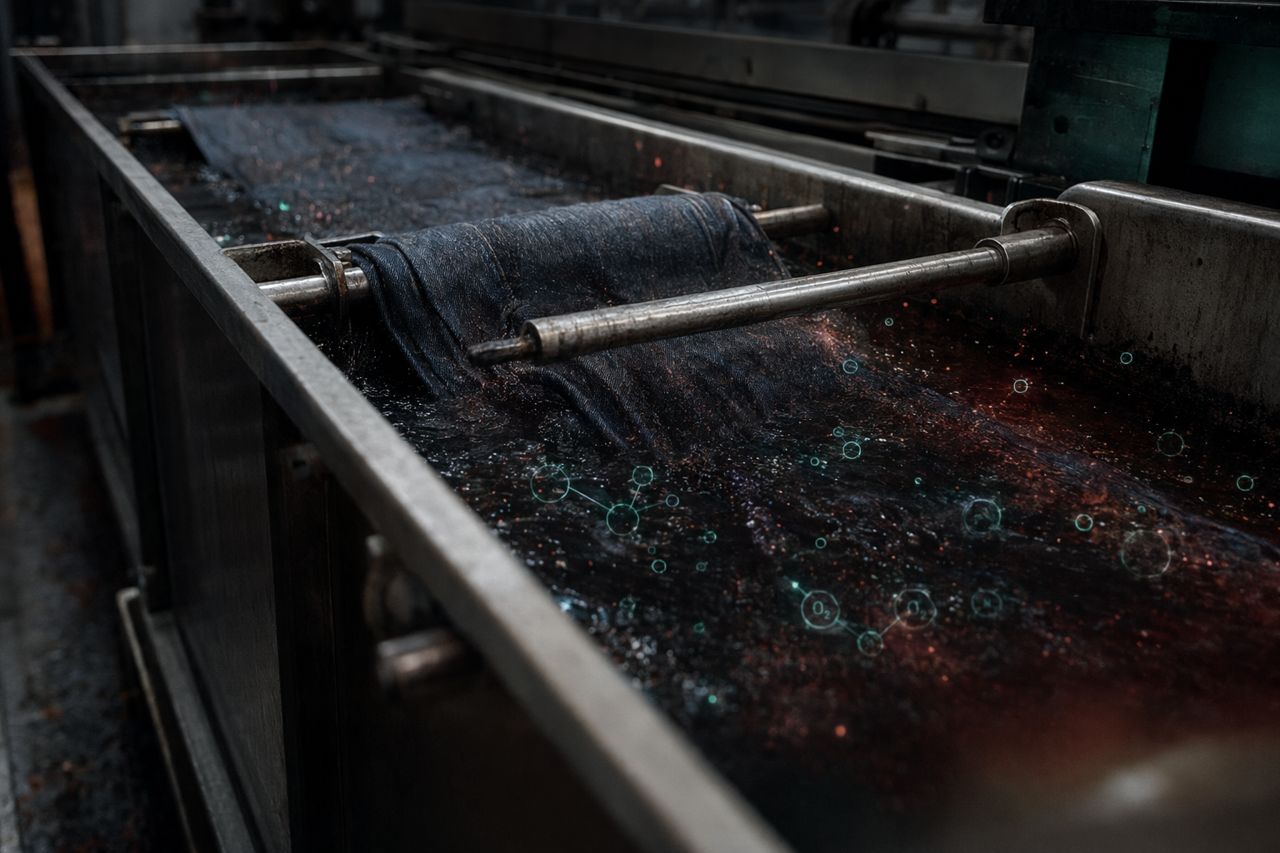
Textiles and denim processing
Laccase can support oxidative treatments where controlled color shift, indigo modification, or surface effect is needed. It is often evaluated in denim finishing, fiber surface modification, and specialty textile processing.
Key buyer questions:
- Is the target dye or surface chemistry accessible to enzymatic oxidation?
- Is a mediator required, allowed, or undesirable?
- Will the treatment affect tensile strength, shade reproducibility, or hand feel?
- Can the enzyme step fit the existing bath temperature, pH, liquor ratio, and cycle time?
- How will residual color bodies be managed after treatment?
For textile processes, pilot work should include shade consistency, back-staining tendency, fabric strength, wash-down profile, and compatibility with surfactants, wetting agents, salts, and finishing auxiliaries.
Pulp, paper, and lignocellulosic streams
Laccase is frequently investigated for lignin modification, pulp brightening support, pitch control concepts, and fiber functionalization. Its value is typically tied to how well it modifies phenolic lignin structures without overprocessing the fiber.
Key buyer questions:
- Is the furnish hardwood, softwood, recycled, agricultural residue, or mixed?
- Is the process goal delignification support, color management, drainage improvement, or surface functionality?
- Will a mediator system be used, and is it acceptable in the mill environment?
- Can oxygen transfer be maintained at the required consistency?
- What effect does the treatment have on strength, brightness stability, and effluent profile?
Laccase should be evaluated against the full mill chemistry, not in isolation. Residual oxidants, chelants, retention aids, fillers, and dissolved organics can shift performance materially.
Phenolic wastewater and process liquors
For wastewater containing phenols, substituted phenols, tannins, lignin fragments, or other oxidizable aromatics, Laccase may help convert soluble compounds into polymerized material that can be separated more readily.
Key buyer questions:
- Which phenolic compounds are present, and at what relative loading?
- Is color removal, toxicity reduction, chemical oxygen demand reduction, or separability the main target?
- Will polymerized products settle, float, filter, or require coagulation support?
- Are inhibitors present, such as heavy metals, sulfites, strong oxidants, or solvent residues?
- What does the sludge or concentrate stream look like after enzymatic treatment?
Laccase is rarely a complete wastewater system by itself. It is more often a targeted oxidative step integrated with clarification, filtration, coagulation, biological treatment, or adsorption.
Wine, beverages, and plant extracts
In polyphenol-rich liquids, Laccase can be considered for stabilization, haze management, phenolic adjustment, or controlled removal of reactive compounds. The value depends on selectivity and sensory protection.
Key buyer questions:
- Which polyphenols are driving instability, color drift, haze, or bitterness?
- Is the product oxygen-sensitive outside the intended enzymatic reaction?
- How will treated oxidized compounds be removed or retained?
- What are the sensory, color, and shelf-life targets?
- What regulatory and processing aids documentation is required for the market?
For beverage or extract use, process validation should include sensory panels, color tracking, turbidity, filtration behavior, and shelf stability under realistic storage conditions.
Biobased materials and polymer modification
Laccase can support oxidative coupling of phenolic groups in lignin, tannin, ferulic acid-bearing polysaccharides, or functionalized biopolymers. This makes it relevant for coatings, adhesives, films, composites, and specialty materials.
Key buyer questions:
- Are the phenolic groups available at the surface or in solution?
- Is crosslinking, grafting, insolubilization, or viscosity build the goal?
- Will oxygen diffusion limit reaction uniformity?
- Does the process need free enzyme, immobilized enzyme, or a one-time treatment?
- What final mechanical, barrier, or adhesion properties define success?
For materials applications, Laccase selection should be tied to end-use testing, not only to reaction conversion.
The practical selection criteria
1. Substrate fit
Laccase favors phenolic and related electron-rich structures. Some non-phenolic targets may require a mediator, but mediator use changes the process economics, regulatory position, and selectivity profile.
Ask for screening against the actual feedstock, not a simplified model compound. Real industrial matrices contain inhibitors, buffers, salts, dyes, surfactants, extractives, and suspended solids that can change the result.
2. pH window
Industrial Laccase products are not interchangeable across pH. Many perform best in acidic to mildly acidic environments, while some fungal or engineered variants tolerate broader conditions.
Selection should compare the enzyme against the existing process pH first. Adjusting pH may be possible, but it adds chemical cost, corrosion considerations, neutralization load, and possible product effects.
3. Temperature fit
Temperature affects rate, stability, oxygen solubility, and compatibility with the product matrix. A higher process temperature may increase reaction speed but reduce dissolved oxygen and shorten enzyme lifetime.
Choose for the real operating profile: heat-up time, hold time, recirculation, shutdown delays, and cleaning exposure all matter.
4. Oxygen transfer
Laccase uses oxygen as the terminal electron acceptor. If oxygen transfer is poor, more enzyme will not always solve the problem.
For tanks, pulpers, textile baths, or viscous material streams, oxygen availability may be shaped by agitation, surface area, viscosity, solids loading, foam control, and headspace management. Treat oxygen as a process reagent.
5. Mediator position
Mediators can extend Laccase activity toward substrates that are difficult to oxidize directly. They can also introduce cost, handling requirements, residue concerns, and selectivity tradeoffs.
Before choosing a Laccase route, decide whether the process must be mediator-free, can use a naturally derived mediator, or can accept a defined synthetic mediator under controlled conditions.
6. Matrix compatibility
Laccase can be affected by:
- Strong reducing agents
- Residual bleaching chemicals
- Sulfites and some preservatives
- Heavy metals and chelating environments
- High solvent levels
- Extreme ionic strength
- Surfactant packages or dye auxiliaries
- Low oxygen availability in viscous or dense systems
Compatibility screening should use the actual recipe or liquor whenever possible.
7. Format and handling
Laccase may be supplied as a liquid, powder, granulate, immobilized preparation, or application-specific blend. The right format depends on dosing accuracy, dust preference, storage conditions, hygiene requirements, process automation, and shelf-life expectations.
Procurement should also evaluate lot traceability, documentation, regional compliance needs, packaging size, lead time, and technical support during pilot scale-up.
What to test before purchasing at scale
A useful Laccase trial should answer process questions, not just confirm that oxidation occurs.
Recommended pilot checks include:
- Target substrate reduction or modification
- Color, clarity, brightness, or shade outcome
- Formation and removal of polymerized material
- Product strength, sensory, or functional performance
- Oxygen transfer and mixing sensitivity
- Enzyme addition point and contact time
- Compatibility with existing chemicals
- Downstream filtration, settling, washing, or clarification
- Residual impact on wastewater or byproduct streams
- Batch-to-batch repeatability under realistic plant conditions
The best specification is the one linked to a measurable process result.
When Laccase is a strong candidate
Laccase is worth serious evaluation when:
- The target chemistry is phenolic, lignin-rich, tannin-rich, dye-related, or otherwise oxidizable
- The process can provide oxygen and controlled contact time
- Selective oxidation is preferable to aggressive chemical treatment
- The matrix is not dominated by strong inhibitors
- The application can benefit from polymerization, color transformation, stabilization, or functionalization
- The downstream process can remove or use the oxidized products
When another route may be better
Laccase may not be the best first choice when:
- The target substrate is not accessible to direct or mediated oxidation
- The process pH is strongly alkaline and cannot be adjusted
- Oxygen transfer is severely limited
- The matrix contains persistent inhibitors
- The process cannot tolerate color formation or polymerized byproducts
- Regulatory, sensory, or residue requirements rule out the needed mediator system
In those cases, an alternative enzyme class, chemical oxidation step, adsorption technology, or combined treatment may be more practical.
Buyer checklist: information to share for a faster recommendation
To narrow the right Laccase option, prepare the following:
- Application area and intended outcome
- Substrate or feedstock description
- Current process pH and temperature profile
- Contact time and mixing conditions
- Oxygen availability or aeration approach
- Full formulation or key chemical additives
- Whether mediators are allowed
- Downstream separation or filtration method
- Required documentation and market region
- Trial success criteria and scale-up timeline
Clear process data shortens the path from screening to commercial decision.
Request a quote for laccase
Laccase Enzyme Solutions supplies laccase wholesale to manufacturers, mills, treatment providers, formulators, distributors and resellers. Price, pack size and lead time are quoted per order.
To get a quote, send:
- the application, the substrate and the result you need
- the quantity you need per order, or your expected monthly volume
- the destination country
- liquid or powder preference, and process pH and temperature if known
More from Laccase Enzyme Solutions
Laccase for Bioremediation and Micropollutant Treatment: Bulk Supply | Laccase Enzyme Solutions
Laccase for Biosensors and Functional Materials | Laccase Enzyme Solutions
Laccase for Cosmetic and Personal Care Formulation Research | Laccase Enzyme Solutions
Laccase for Food Processing & Ingredient Modification | Laccase Enzyme Solutions
Laccase for Green Oxidation Chemistry | Laccase Enzyme Solutions
Laccase for Lignin-Based Biomaterials | Laccase Enzyme Solutions
Request pricing & specs
Tell us your application and volume — we reply with pricing and lead time.
We have received your message. We will reply by email.