

How Laccase Works: Mechanism and Reaction Guide for Process Buyers | Laccase Enzyme Solutions
How the laccase reaction works, what decides whether it fits your process, and what manufacturers, mills, treatment providers and resellers should specify before ordering laccase.
Laccase is an oxygen-driven enzyme that pulls electrons from phenolic and related aromatic compounds and passes them to oxygen, which ends up as water. What happens to the oxidized compound next depends on your process: it may couple into larger molecules, change color, settle out, or become more stable.
This page is for the people who have to make that reaction work in a plant and buy the enzyme for it: textile and denim finishers, pulp and paper mills, wastewater treatment providers, beverage and extract processors, materials developers, and the distributors and resellers who supply them. It explains the mechanism in plain process terms and lists what to check and send before you order.
Wholesale and bulk supply. Laccase Enzyme Solutions supplies laccase to manufacturers, distributors and resellers. Send the application, the quantity you need and the destination country; every order is quoted individually. Request a quote
The reaction in one line
Laccase, formally Laccase (benzenediol:oxygen oxidoreductase), belongs to the multicopper oxidase family. It removes one electron at a time from a suitable substrate and uses molecular oxygen as the final electron acceptor, reducing it to water.
For a buyer, that has two practical consequences:
- Oxygen is the oxidant. Your process must be able to supply it. Poor mixing or an oxygen-starved vessel limits the result.
- The enzyme starts the change; your process finishes it. Laccase creates reactive radicals. The matrix, pH, contact time and downstream steps decide what those radicals turn into.
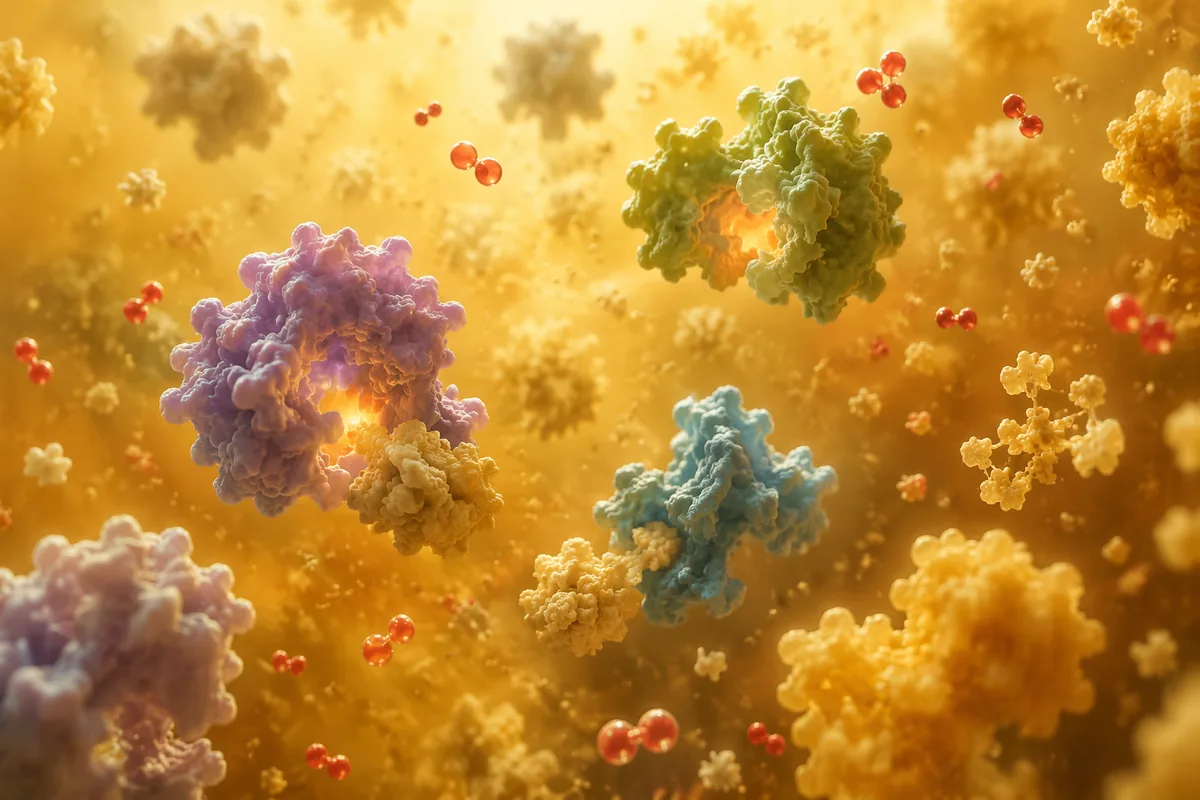
Step by step: how the electrons move
- A compatible substrate reaches the enzyme surface.
- Laccase removes one electron from it.
- The substrate becomes a reactive radical.
- The electron passes through the copper centers inside the enzyme.
- Oxygen is reduced to water.
- The radicals react further in the surrounding liquid, fiber or slurry.
The enzyme does not usually carry out the whole industrial transformation on its own. It supplies the oxidative step; the process conditions decide the outcome.
What the oxidized compounds turn into
| Outcome | What it means in production |
|---|---|
| Coupling | Radicals join into larger molecules. |
| Polymerization | Phenolics build into higher-molecular-weight structures that may be less soluble. |
| Modification | Complex aromatic structures such as lignin become more reactive or easier to process, often with a mediator. |
| Color change | Chromophores form, fade or shift, depending on the substrate. |
| Separation | Oxidized phenolics become easier to settle, filter or remove from a liquid stream. |
| Stabilization | Reactive phenolics in beverages, extracts or plant materials turn into less troublesome forms. |
This is why one enzyme shows up in textile finishing, pulp and paper, wastewater, beverage stabilization and bio-based materials: the same electron transfer, steered by different process conditions.
Which substrates laccase acts on
Laccase is most relevant for compounds that give up electrons under mild conditions:
- phenols and substituted phenols
- catechols and hydroquinone-type structures
- aromatic amines, in selected applications
- lignin-related compounds
- tannins and plant polyphenols
- certain dyes and chromophores
- phenolic contaminants in water
A compound can be chemically suitable and still out of reach: trapped inside a fiber, bound in a dense polymer, or shielded by process additives. Accessibility belongs in the trial plan.
Direct oxidation or a mediator system
Some substrates are oxidized directly. Others need a mediator: a small redox-active molecule that laccase oxidizes first and that then carries the oxidizing power to substrates that are too bulky or too hard to oxidize directly.
Mediators widen the range of jobs, especially in lignin modification, textile chemistry, specialty pulp treatment and difficult phenolic waste streams. They also add questions a buyer has to answer: mediator cost, residues, compatibility with the final product and the effect on downstream treatment. See laccase mediator systems for the detail.
The process conditions that decide the result
| Factor | Why it matters |
|---|---|
| pH | Affects enzyme stability, substrate ionization and radical behavior. Many industrial systems run mildly acidic to near neutral, but the right window depends on the application. |
| Temperature | Higher temperature can speed the reaction but may shorten enzyme life. The target is the balance between conversion, stability and process time. |
| Oxygen supply | Laccase needs oxygen. Weak mixing, high viscosity or oxygen-limited vessels cap performance. |
| Contact time | Too short under-converts; too long can over-oxidize. |
| Substrate concentration | Very dilute streams may be limited by mass transfer; very concentrated ones may need staged dosing or stronger mixing. |
| Inhibitors | Sulfites, strong reducing agents, interfering metals, preservatives and some surfactants can reduce performance. |
| Solids | Fibers, pulp, suspended solids and plant particles can help or hinder, depending on access and mixing. |
What the mechanism means in each industry
Textiles and denim
Laccase drives controlled oxidation of dye and fiber-associated chromophores. The buying question is selectivity: shade adjustment, backstaining control or finishing effect without fiber damage or uneven lots. Screen on fabric construction, dye class, liquor ratio, pH, oxygen transfer, auxiliaries and rinse design. More on textile and denim finishing.
Pulp, paper and lignocellulosic materials
Laccase modifies lignin-rich surfaces and is evaluated for brightness development, pitch control, fiber functionalization or a better response to downstream chemistry. The goal is controlled oxidation at the right point in the line, with attention to pulp consistency, residual chemicals, residence time and the bleaching or retention system. More on pulp and paper delignification.
Phenolic wastewater and process effluents
Oxidation can turn dissolved phenolics into coupled products that are easier to separate, filter, settle or treat biologically. Assess COD profile, phenolic load, pH swings, solids handling, oxygen transfer and whether the oxidized material stays dispersed. More on phenolic wastewater treatment.
Wine, juice, tea, extracts and plant-derived liquids
Laccase is evaluated for polyphenol management, haze reduction, color stabilization or removing reactive phenolics from botanical streams. A reaction that works technically must still keep the sensory profile of the final product. More on wine and beverage stabilization.
Biopolymers, coatings and materials
Radicals formed on phenolic structures support crosslinking and surface functionalization for bio-based coatings, adhesives, films and specialty materials. More on lignin-based biomaterials.
What to test before you scale up
Run trials on the real matrix, not a clean lab substitute. Before scale-up, define:
- the target substrate or quality attribute
- the direction of change: removal, coupling, color shift, stabilization or surface activation
- the pH and temperature range your process allows
- how oxygen is supplied and the mixing limits
- the contact time available on the line
- additives, preservatives, reducing agents or metals present
- downstream separation, filtration, rinsing or finishing steps
- regulatory or residue requirements for the final application
Why laccase trials fail
Failed trials rarely mean the chemistry is wrong. They usually mean the process fit is: too little oxygen, the wrong pH, reducing agents in the formulation, too short a contact time, a substrate the enzyme cannot reach, uncontrolled mediator chemistry, or a downstream step that undoes the benefit. A structured screening plan finds these constraints quickly. The troubleshooting guide covers them one by one.
What good performance looks like
Judge laccase in process terms:
- faster or cleaner oxidation of the target substrate
- less reliance on aggressive oxidants
- better color, brightness, clarity or stability
- better separation of oxidized phenolics
- less process variability
- compatibility with existing equipment and residence time
- a cost in use that purchasing can defend
Questions to put to any laccase supplier
- Which substrate classes is the grade suited to?
- What pH and temperature window is realistic in my matrix?
- Is direct oxidation expected, or is a mediator needed?
- How should oxygen transfer be handled at production scale?
- Which additives are known to interfere?
- What storage and handling suits my plant?
- What documentation is available for my industry?
- Will the supplier help design a trial around my actual process conditions?
Request a quote for laccase
Laccase Enzyme Solutions supplies laccase wholesale to textile finishers, mills, wastewater treatment providers, beverage and extract processors, materials developers, formulators, distributors and resellers. Price, pack size and lead time are quoted per order.
To get a quote, send:
- the product or application, and the substrate you need to oxidize
- the quantity you need per order, or your expected monthly volume
- the destination country
- liquid or powder preference, and process pH and temperature if known
More from Laccase Enzyme Solutions
Laccase for Bioremediation and Micropollutant Treatment: Bulk Supply | Laccase Enzyme Solutions
Laccase for Biosensors and Functional Materials | Laccase Enzyme Solutions
Laccase for Cosmetic and Personal Care Formulation Research | Laccase Enzyme Solutions
Laccase for Food Processing & Ingredient Modification | Laccase Enzyme Solutions
Laccase for Green Oxidation Chemistry | Laccase Enzyme Solutions
Laccase for Lignin-Based Biomaterials | Laccase Enzyme Solutions
Request pricing & specs
Tell us your application and volume — we reply with pricing and lead time.
We have received your message. We will reply by email.